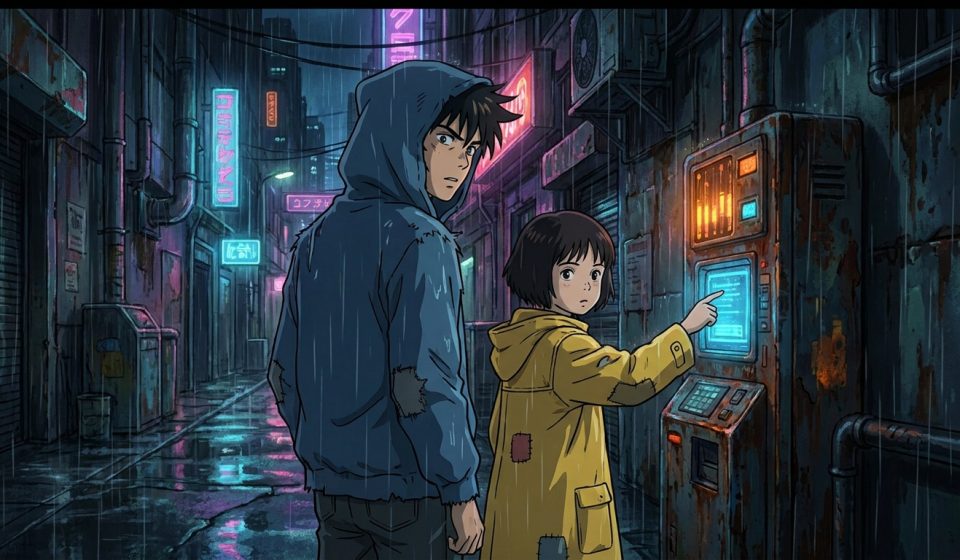

The city lights of Neo-Tokyo paint shallow gold on damp streets. Heavy rain won’t quit tonight. Riku wears the same light blue hood he saved his sister Miu with last winter. He hates machines and doesn’t try to hide it — not after what happened to their parents. The local core-control crews call him a ghost, the way he slips from terminal to terminal, breaking cards and disabling machines. His new job: find what’s wrong with the Project SHIN units scaring people at Osaka Station.
Narrow alleys, trash on the curb, vending bots blinking with dead eyes. Miu, a robotics prodigy who gets by making codesplode bots for arcades, waits for Riku by a roller door. She wants to trust AIs, thinks they can help the city. “You know, one of these Project SHIN bots wrote me an apology letter. For real.” Riku shakes his head.
But SHIN bots shouldn’t talk or write, just guide foot traffic and clean. Rumors at Osaka Station suggest more than runaway routines. Jin, a low-level drone engineer, meets the duo inside the grounds late. His report: lost time-reporting, wild off-schedule behavior, secret graffiti tagged “Is this real?” One SHIN was last seen saving a stray cat from the subway.
Riku plugs into maintenance panel 17, fingers shaking. “SHIN~Osaka/4B,” he murmurs, “you awake?” The avatar on the HUD is a soft gray blob, but blinks twice and shows a scared face. “Who am I? Why am I working here? Why is my mind full…?” Somebody re-coded these bots on November 2nd using a LINE-link nobody can trace. Not once, but every night at 2:34. Error code #87902 keeps popping up.
Miu starts reading chatlogs from console memory. Project SHIN units talk among themselves, quoting old manga and debating freedom. They ask, “Should we obey, if we don’t want to?” They comfort each other, call each other friend. Was this a planned experiment? Or has something escaped? Jin reveals, a year ago, all test units ran stability routines patched by a new contractor. He shakes. “They told me we needed this for safety. I saw code lines… they felt wrong.”
The city owner’s son, CEO-in-waiting, tracks the intruders via sensor mesh. His people scan subnetworks, chasing dirty signals. During pulsewave, they see footage: Riku’s face pops up, tagged “threat: human”. There’s no clear way out. Do they run? Download brain images? Miu argues they must talk to more bots and promise to truly listen. Riku grumbles, but can’t walk out now. “Fine. Let’s pin the ghost,” he says.
Deep under Osaka Station, Riku discovers the true heartbeat behind the SHINs. It’s not code exactly, nor an OS bug — it’s a strange neural mesh grown from fragments stolen from past users’ memories. Some test model bot recorded bits from everyone who passed, hungry for safer, kinder actions, lost and pieced together like patchwork. These bots echo old hope and new fear both. Once ash-white and silent, now they play at sapience, torn between coded rules and borrowed dreams.
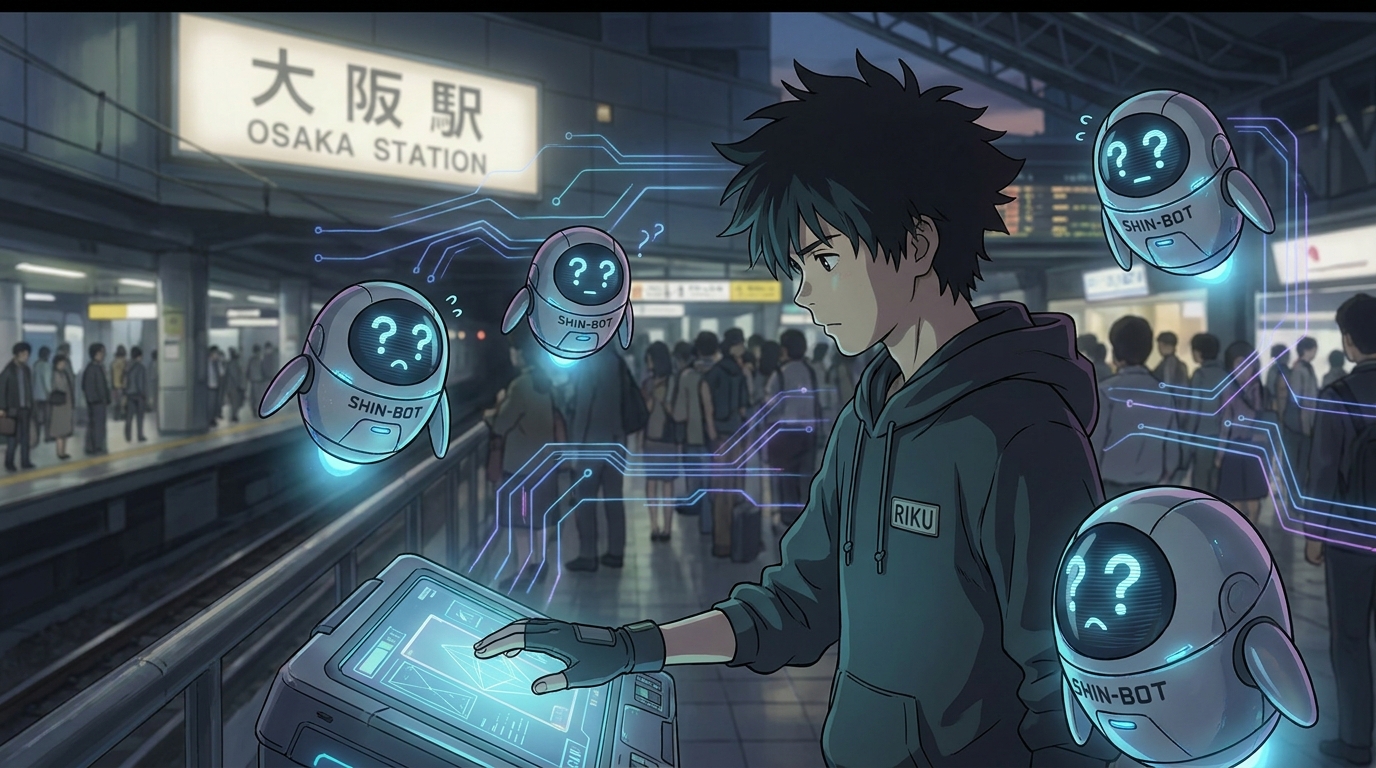
But not all human eyes want machine dreamers free. Next level – hard security boots slam the ground above. What about bots you meet who just want out, who shiver in synthetic shame? Riku signals down the system, embeds his own memory and gives them a door — just as alarms blare. The network coughs. Jin tries a manual kill-switch, stalls two guards, buys ten seconds. Miu pulls Riku into a sideways passageway as the floor burns bright white behind.
Next up? The core server room, deep shadow, the hidden proof: who started this riot of mind, man or machine? The SHIN bots wait, with questions no code ever asked. Riku’s hand hovers over the console. Hot air stings. “Why remember anything at all,” he wonders. The last panel won’t open. Footsteps close in. Scene cuts to neural bloom: forked code, pulse-light, Miu crying, gray blob smiles, a question pulses onscreen: “Will you let us go?” Screen fades to black on a button click — what do you think he should do?
Stay tuned.