
Reflections in Twilight: The Case of the Vanishing Faces
Rain tapped the glass as Kaede Soma ran home past still blue puddles. He’s always avoided mirrors in dark places. For most boys, it’s just a childish dare. For Kaede, it’s a hard rule. Why’s that? Ever felt a shiver run down your back and didn’t look over your shoulder?
Kaede lives with his grandma, flowers, and rules about windows shut by nightfall. The story starts as Kaede’’s school prepares for a drama night. His childhood friend Haruka Shimizu heads makeup. But three students claim their faces now blur into white, with eyes gone when seen in big glass at dusk. They speak of whispers from empty glass. Most think it’s stress-induced. Haruka isn’t sure. She asks Kaede, ‘Didn’t this happen to your cousin last year? They’re still in therapy, aren’t they?’
That night, Kaede’’s grandma takes down mirrors. Kaede wakes near midnight, hearing glass creak. He finds Haruka at his doorstep in rain, hair and shoulders wet, face pale. ‘Something followed me. I saw it in your window.’ She clutches his hand. Do you have a window rule at your place too?
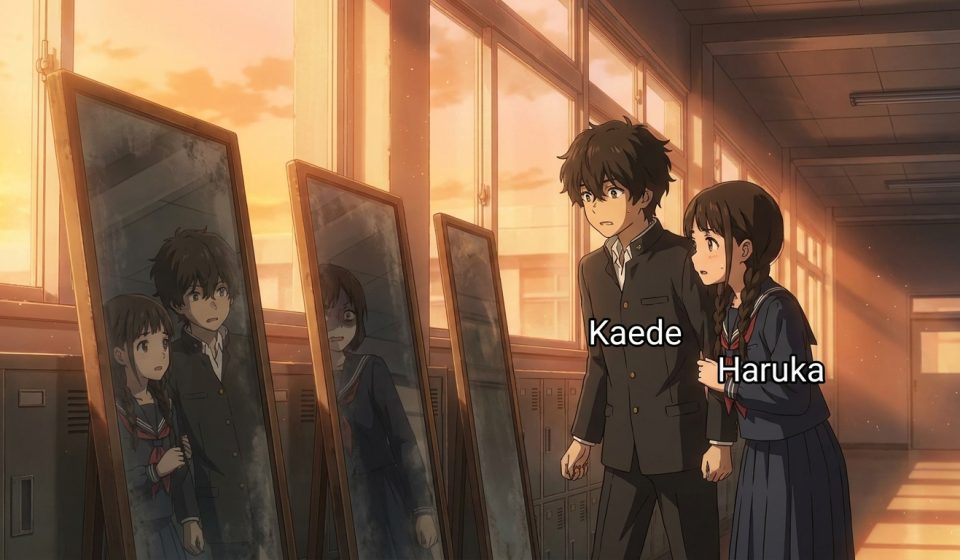
The story’s set in Sakuragaoka, where superstitions fade in daylight. But for Kaede, evening holds more than shadow. The two visit Yuto Akamine, a shy boy whose face all but vanished ten days before. Yuto mumbles: ‘It almost got me. Don’t sleep by glass.’ When Kaede leans near the covered mirror, something cold slides over his fingers—he jumps back. ‘Do you feel that?’ he whispers to Haruka. She bites her lip, staring into nothing. ‘It’s like… it waits only when we’re awake.’
As fear spreads, a teacher, Miss Azuma, tries to talk sense. Kaede hears her late one night. ‘The old stories must die. They force students to panic.’ By that morning, Miss Azuma appears up late, eyelids rimmed pink, saying odd things. In class, Haruka notes her gaze slides over everyone’s head as if tracking shapes we can’t see. Kaede wonders, but keeps voice low: ‘Does she still have her face?’
The school drama rehearsals press on. Sparse crowds, tense staff, students with makeup streaks washed by tears. Kaede researches old town tales. The Vanishing Face folk legend turns up—a pale shape in the pane, taking your eyes if you watch too long at dusk. He finds sketches in a library book, drawn with trembling lines and dated 1946. Do you think a lost spirit might like mirrors, even today?
On a dare, classmate Ken Yoshida sets up a phone to record after six in an empty band room. Next morning, only static and shapes shaped like cheeks flickering by with not-quite eyes. ‘That’s not dust,’ says Haruka, voice small. 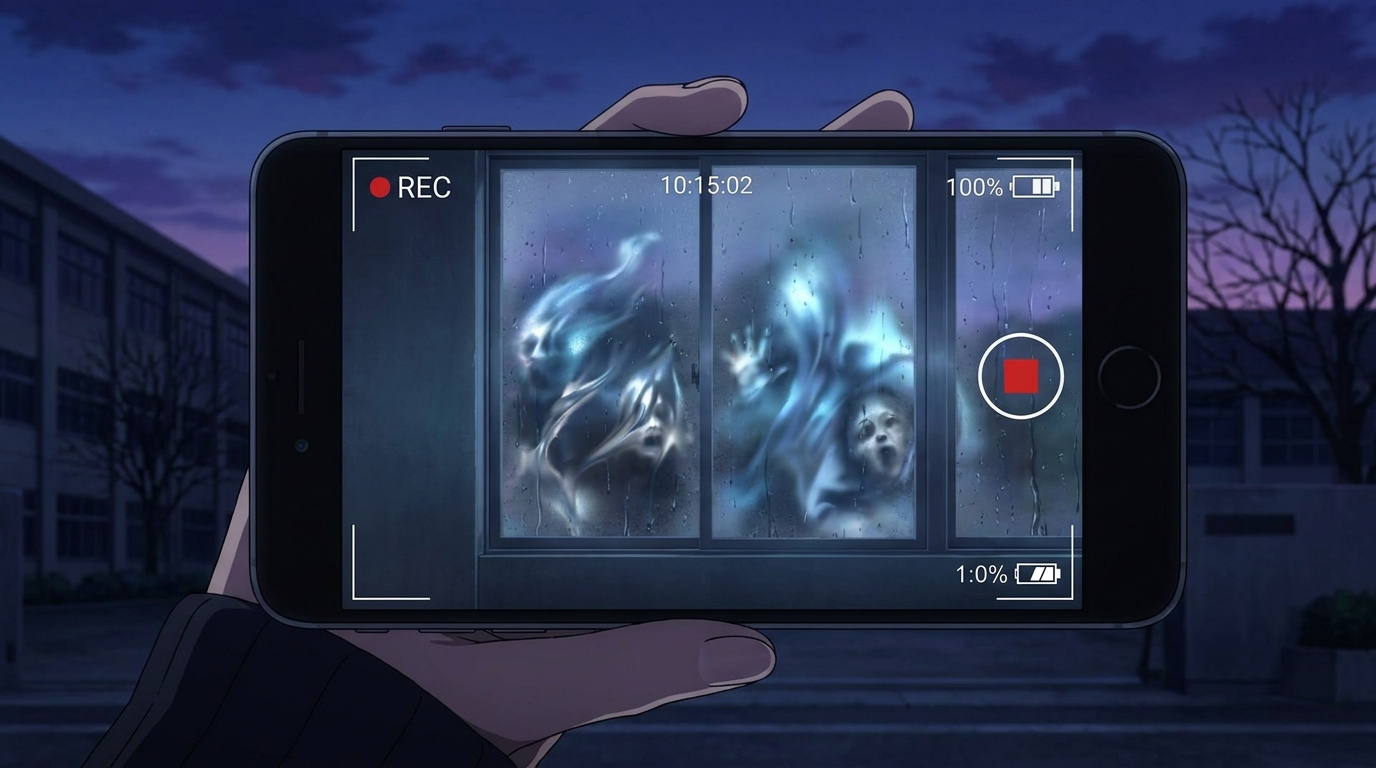
Three disappear from school records the next day; no trace in the glass-walled east wing.
Haruka and Kaede talk in whispers, fearing more than teachers. Haruka suspects the glass in school basement—a whole wall from an old shimmering mansion. Grandma reveals that night: ‘Your mother sealed an angry soul inside a glass she never watched at night’. She gives Kaede a tiny Japanese bell. ‘Shake it—shadows avoid sound.’
The next test: Kaede and Haruka string the bell above windows. Tomoko, their jokey friend, scoffs: ‘This fake thing? If the bell works…’ That evening, Tomoko’s laughter dies as the window grows black, bells ringing by themselves. Kaede drags Haruka out as coldness clawed at their feet, slamming a door against air that moves like water. Did you ever see something out of the corner of your eye and think it might see you too?
Every night, the glass gets heavier. Students invent codewords, avoid mirrors, check faces in polished boards not glass real. Miss Azuma babbles more at her desk. School grows cold once the sun sets. Flowers wilt near unwashed windows. Would sort of fog live in glass if no one were left to see?
By week’s end, half of Kaede’s grade’s homes are sealed with blackout paper. Many stay silent. On a dare, Kaede brings a camera, bell in hand, to the east wing’s wall. Shot from the phone catches wavering shapes that shift ever nearer when he blinks. Haruka writes a message, ‘Don’t look at their eyes,’ over all locked-room doors. No one wants to stay after sunset, but the final rehearsal’s set for dusk. Suddenly, the bell by the glass cracks. There’s tapping on every window: shapes pressing forward. Grandma rushes to the door—but her face flickers, quiet but real. Kaede hesitates—can you trust blood when the shape wears your face?
It ends in a sharp cut—Kaede is face to face with his not-face self, hand against glass as thin as a dream. He whispers, ‘If I turn away, do you fade or do I?’ Haruka calls his name. Water runs down the pane. Fade out. 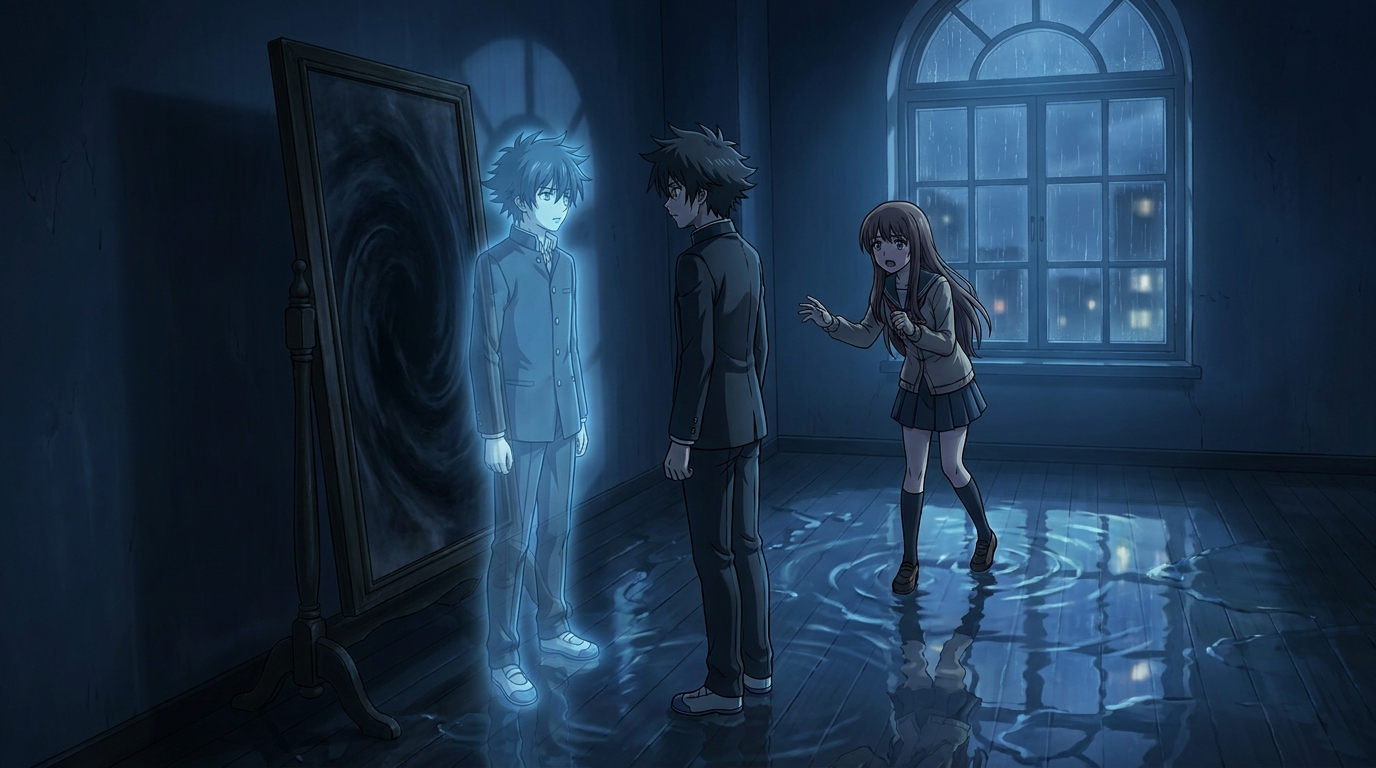
(To be continued.)