
Synopsis
Have you ever felt like the fate of your school (and maybe the future) hung on one experiment? Meet Kazuo Sato, our glass-wearing, always-messy-haired second-year student at Tomigaoka High. He’s obsessed with uncovering how things work. But his real dream? Prove he’s more than just ‘that science geek.’ Ever felt the urge to step out from a shadow? Well, Kazuo’s about to get his shot when the national Future Researchers’ Expo drops an unmissable challenge: design a real experiment—the best in Japan—and you’ll get access to the ISS for 48 hours, plus a full grant.
Kazuo’s club fumbles with big ideas: can you synthesise medicine from schoolyard weeds? What if static charge can charge their whole building? Enter Natsuki Rina, a volleyball ace who flunked her last science test but whose street-smart mind asks, ‘Why can dogs smell better than robots?’ Together with tiny genius twin Hinata (who no one takes seriously), stern physics head Mai, droopy math nerd Joji, and Ayane, who is more into drawing labels than doing tests, they form a team you wouldn’t bet on. Will their maddening mix of questions, lost notebooks, and spillage disasters unlock a never-seen result or walk in last place?
“What if we shock people with how fun chemistry can be?” Ayane grins, spattering cola everywhere. “No more smelly eggs this time,” Mai pleads, pinching her nose.
The club sets out to fuse real curiosity with wild ideas. Their experiments fail. Rockets don’t fly. Some frogs seem to vanish.
One week left. Their rivals—slick, uniformed teams from advanced schools—parade perfect blueprints and sponsor banners. Is everyone smarter? Why even try?
At their lowest, ironic help arrives: the stern chemistry teacher, Mr. Kumada, who hides a secret love for sci-fi. “We’re stuck, sensei,” Kazuo confesses. Mr. Kumada only smiles. “You kids know more than you think. Science isn’t tidy till it surprises you. Let it. Ever lose something in your mess, then find hidden energy?”
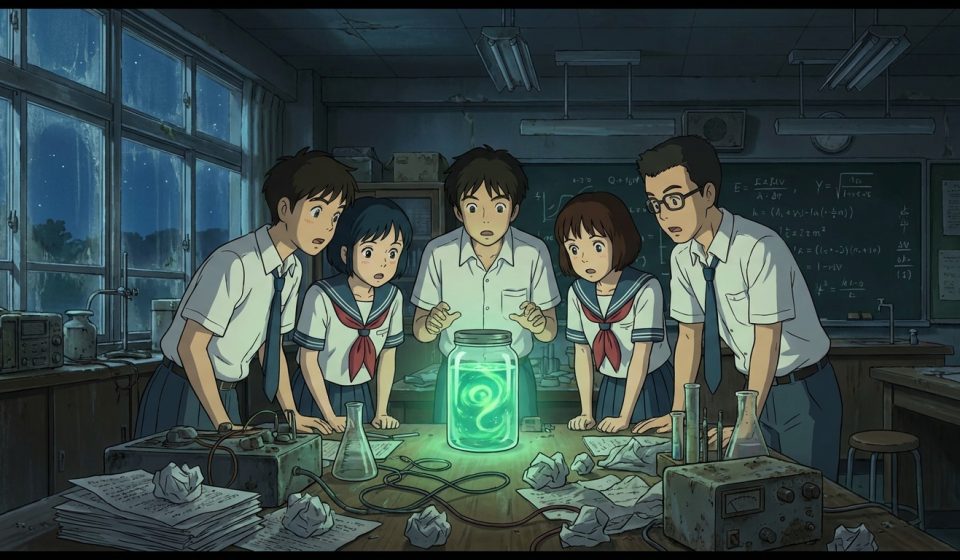
Late into the night, Rina blurts, “All dogs bark, but some don’t howl. Maybe there’s gaps even in simple rules. That’s your lesson, Kazuo.” Suddenly, Hinata runs in—and shows the club a jar glowing faint green in the dark.
A failed attempt from Joji to make bacteria grow faster turned phosphorescent! What does this mean? The team soon realizes: the natural world holds power in things most overlook. They choose one final experiment—proving communication between simple bacteria can be tweaked with magnetism. It sounds wild.
What results will actual lab tests show? Kazuo is sure: “No one is going to play it safe this time.”
The day arrives. Spectators watch nervously as spark lines jump across petri dishes. Green spots move, pausing together—a form of tiny ‘conversation’ between living cells, pushed by Kazuo’s finely steered magnetic field. Judges murmur. Sure, they’re no polished team. But the experiment glows clean and odd. Some claim a flaw. One teacher insists nothing was proven. Was the spark a trick?
Rina can’t help but grin at those doubts. “Wouldn’t you rather chase questions than only fill out forms?” Main rival Chiaki grimaces. “Luck isn’t science.” Taiyo, another classmate, raises his brow. “Next year will you test dragons too, Kazuo?” Everyone laughs. But as the team packs up, a judge lingers behind.
He leaves them with words: “Your work changes things, not because it gave the right answer—but because you took real risk for truth. You just lit a bigger fuse. Can you handle that?”
Rina squeezes Kazuo’s sleeve. “Do you think we made a real mark? Or did we just have fun and fake it well?” What would you feel in Kazuo’s place right now?
Next day, strange readings cross the school’s sensors. Their ‘failed’ bacteria seem to keep glowing, almost moving on their own, outside the old petri dish. What wild process has begun, and what did the team really make?
Cliffhanger: In the dim clubroom, Kazuo stares at eerie new results flickering on their screen. He can’t blink. Has curiosity pushed them too far, or will their next trial break rules for good?