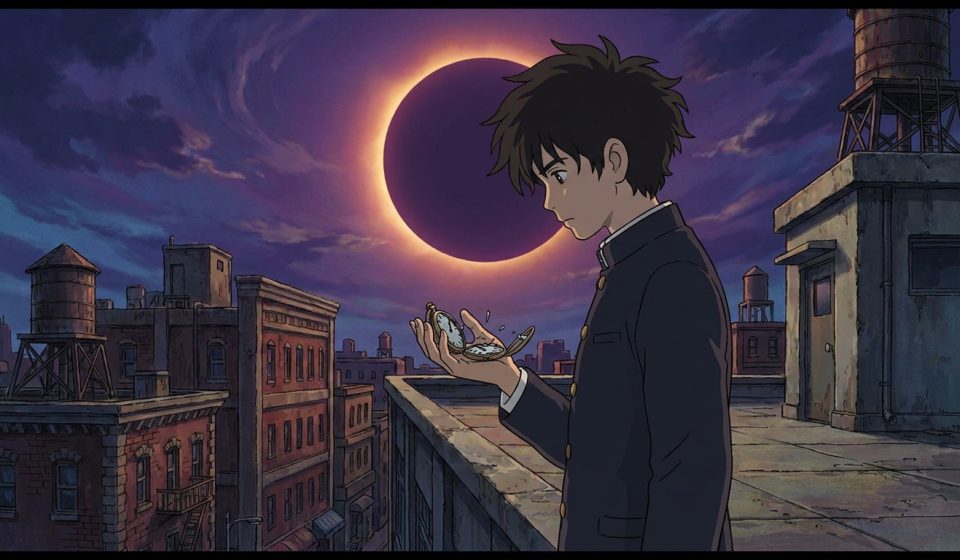

Fragments Through the Hourglass
Only the hands of time keep Riku Kase, age 16, from his goal: to fix his mother’s mysteriously vanished past. Born in Tokyo a dozen years ahead, Riku lives now with fragments: lost photos, stories his mother can’t or won’t finish, places in old towns where faces react strangely to their arrival. After a night alone on the school’s ancient rooftop, Riku watches the eclipse—not so rare, but that evening, the deep brass dome clock unspools, colors blend, and somehow, Tokyo shatters open—or is it Riku—and he’s slipping out, waking up in 1998.
Wanna try to puzzle out the shape of your family with a fractured mind and running out of time? That’s the sort of mood his journey catches. Riku is not alone long. Yuna Mishima shows up; she wears wide jeans and a strange, watch-face necklace. Instant skeptic, she studies Riku’s shining new digital phone with no signal, laughing, “You’re stuck too, huh?” Fast bonds form. If you fell through time with no plan, who do you trust first?
Yuna’s lost her brother in the tumble between years. Together, they follow rumors about the Watchmaker—an adult said to appear at sudden moments around clocks or lost corners in the district. Riku learns the past keeps secrets, right down in city light and the clatter of trains. Memory hurt isn’t so easily fixed.
Other travelers arrive. Kenji, equipped with an old Gameboy that seems out of place even here, shares dreams of returning to a certain baseball game he never finished. Hana, eyes distant, knows snippets about when you break rules. Sharing tiny facts, uneasy smiles and leftover food scraps, they dodge strange pulls as time splits further: scenes where sunlight turns cold or voices echo in odd ways, flickering from sight—but snapping back after a second.
Why do you think time rips at the lined seams where secret shame lives? Riku and Yuna find people with ties, all running. Signals point to the old clock tower. By episode four, our group learns a failure in the distant past triggers each rift’s rebound; the clock tower covers some old sin, its doors left shut for almost twenty years. If time runs out, can they fix what shattered—and decide what’s worth pulling from the ashes?
The Watchmaker appears in episode five. It’s not a man at all, but twin children in monochrome uniforms, their tools moving on wires almost too quick to follow. “If you want to leave here, you trade a memory you trust.” Mix loss and hope—will you give away your best year, or the day you first hugged your mother after a nightmare? Choices carry the group close, so close they taste midnight blue light on the lip of dawn.

In fight-or-flight, more light rips the clock tower. Hana isn’t found when time’s flex pulls—just the echo of her voice naming a date that never was. Yuna’s brother appears, but doesn’t remember her; great cost. Kenji throws his Gameboy to keep the gears from grinding Riku’s last photograph of his mother to dust.
Riku has the final choice. He can save his photograph, or open the last room with a key clicked from the hour hand itself. He hesitates, holding tight. Would you?
The screen whites out on his hand shaking. Yuna stares, mouth open, but the sound cuts out. Doors open—then snap shut. Episode ends: past and present ripple, group splintered across years, kick-starting the new arc. What memory would you risk for one lost truth? The answer waits—in Fragments Through the Hourglass, part two.